City of Francistown
Francistown is a city in the North-Eastern zone of Botswana, near the Zimbabwean border (Ramokgwebana Border). The city was founded in 1897 when the railway line, which the British South Africa Company was constructing, reached Monarch on 1st September 1897.
The line was part of Cecil Rhodes’ dream of building a railway from Cape to Cairo and passed south of Nyangabgwe Hill because it was the shortest route to Zimbabwe’s Bulawayo. The development of the city was prompted by a 19th-century gold rush as Daniel Francis, an English Prospector from Liverpool, United Kingdom, acquired prospecting licenses in the region in 1869.


The settlement that was established thereafter, was called Francistown, named after Daniel Francis, who was also one of the founding directors of the Tati Concession which virtually owned most of the land in the area. Daniel Francis was an English prospector who became a founding director of the Tati Concessions Company and after whom the city of Francistown, Botswana, was named. Francis acquired prospecting licenses in the area in 1869, and in 1897, the company sold land for a settlement that marked the birth of modern-day Francistown. The town began as a gold-mining center during the region’s first gold rush and was established as a commercial hub due to the mining operations.
There is also the historical Blue Jacket Street in Francistown which was named after an early prospector, Sam “Blue Jacket” Anderson, who was a Danish miner known for always wearing a blue jacket. The street is the main thoroughfare in the city center and was named in his honor after the Blue Jacket Gold Mine, which also derived its name from the prospector. The street represents the city’s historical connection to gold mining, which was a foundational part of its economy in its early days.
The Haskins family played a significant role in the history of Francistown, Botswana, as prominent businessmen, politicians, and early adopters of modern infrastructure and social progress. James “Monang” Haskins established a trading store chain in the area, while his son, James George Haskins, was a key figure in politics and business, co-founding the Francistown Chamber of Commerce and serving in the first parliament of Botswana after independence. Their legacy includes creating jobs, building the Grand Hotel, and having Haskins Street, the first tarred road in Botswana, named in their honor.
Between 1936 and the 1980’s Francistown’s economy was hinged on the Witwatersrand Native Labor Association (WENELA) a company that vigorously recruited labour for South African mines. However, what seemed to have been a noble initiative to transport labour through air by WENELA to South Africa turned into disaster in April 1974 when a four engine Douglas DC Aeroplane crashed and killed over 70 passengers. Those who witnessed the accident describe the grim scene as an indelible scar that will never fade away from the memories of many residents of Francistown.


The history of Francistown is synonymous with the aching story of the liberation struggle in Southern Africa. Many nationalist leaders from the Zimbabwe African National Union (ZANU), Zimbabwe African’ Peoples Union (ZAPU), South West African People’s Organization (SWAPO), used Francistown as a transit on exile or an area to get in touch with their fellow liberation fighters.
Some of these leaders include among others, Former President of South Africa Thabo Mbeki and Joe Slovo of ANC, Former Presidents of Namibia Sam Nujoma and Hifikeponye Pohamba and Herman Toiva Ja Toivo of SWAPO, Former President of Zimbabwe the late, Robert Mugabe, Joshua Nkomo and Dumiso Dabengwa of ZANU and ZAPU and John Mabunda of FRELIMO.
All these political activities brought with them terror to the people of Francistown. Bomb blasts haunted Francistown from Mophane club, Blue town and Satellite locations. Some of the significant historical events in Francistown include an aeroplane that burnt down to ashes when it was supposed to take South African refugees to Tanzania in 1964, the bombing of a house in Bluetown that had refugees from Zimbabwe in 1976, the attack of the then Police Mobile Unit(PMU) in 1976 by the Rhodesian army which compelled the Botswana government to establish a military.
Nonetheless, Francistown has over the years transformed into a modern city although it is plagued by economic challenges. It has an international airport, malls, hotels and stadiums. It was declared a city in 1997. Francistown was declared a Township Authority (FTA) to conduct the affairs of the township. At independence in 1966, the Francistown Town Council (FTC) was established for the governance and administration of the aforesaid Township. This was executed to secure and promote the health, order, and good governance of the Town. The FTA’s first Mayor was Honorable Paul Mincher.
In 1971, about 100, 000 acres of farmland were signed over to the Botswana Government by Tati Company Limited, and in 1973 the company handed over its mineral rights to the government. In 1997, when Francistown turned 100 years old, it was declared a city, whereas the Francistown Town Council (FTC) had to shift and transform into the Francistown City Council (FCC).
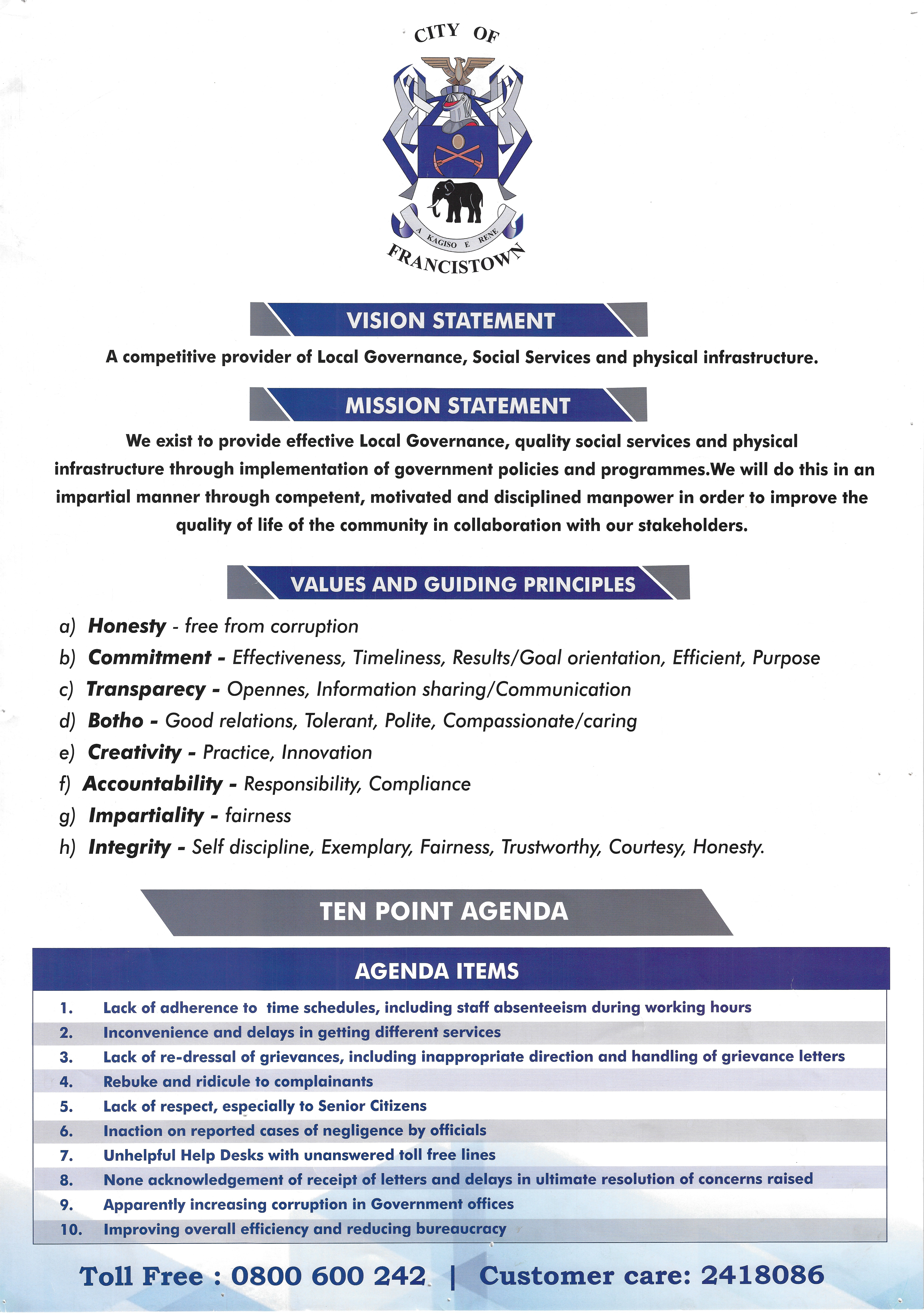
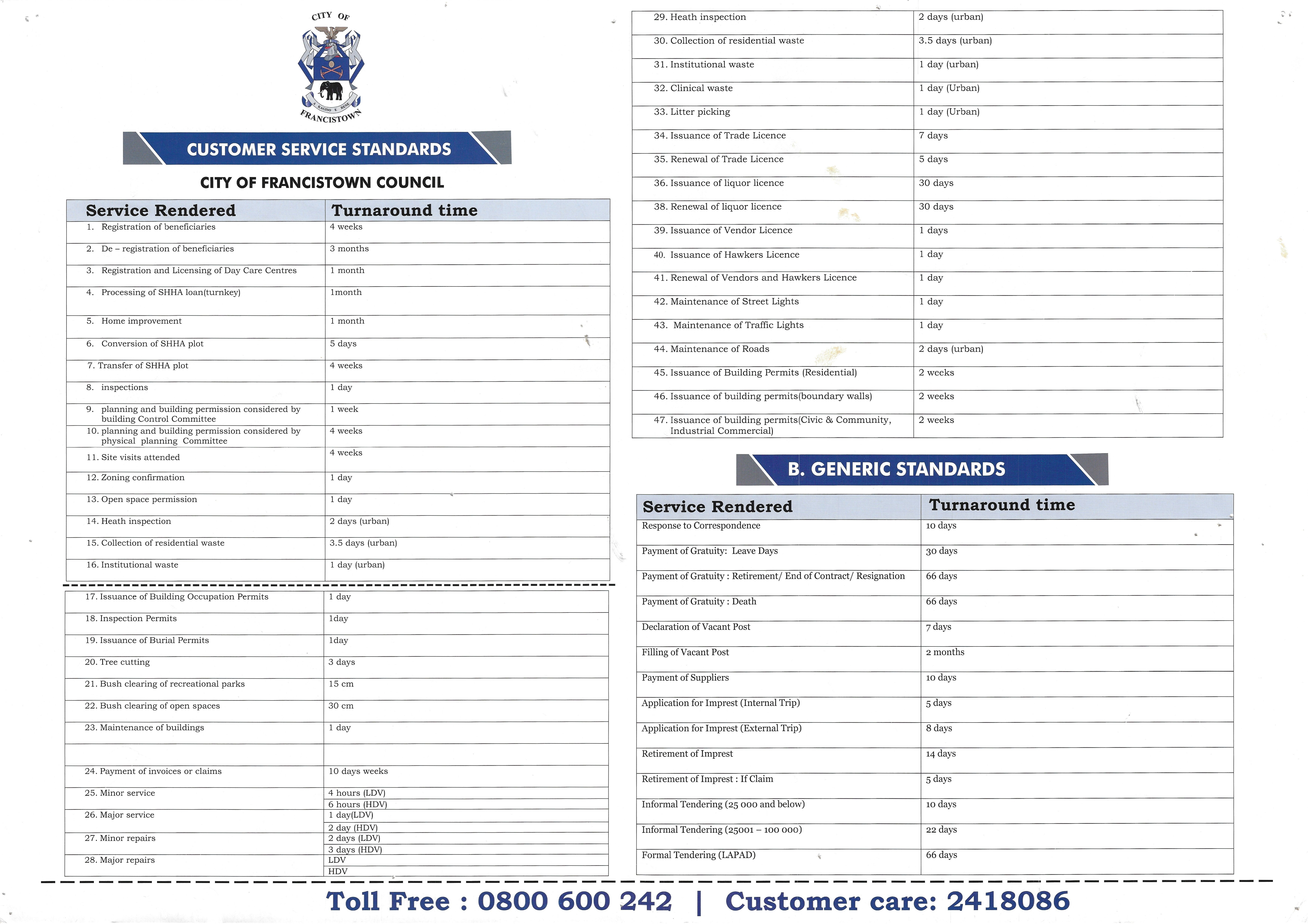
The first Mayor of the Francistown City Council was Honorable Motlatsi Molapisi. To date, the Council provides quality social services and physical infrastructural development to the community of Francistown through the implementation of government policies and programs.


The council does this in a practical manner through various departments to ensure proper service delivery. For the past decades, Francistown has been experiencing a period of rapid growth. This can be attributed to the growth of the commercial and industrial sectors in the city.
The city prides itself as the hub of commerce and industry in the northern part of Botswana and provides a linkage with our Southern African Development Community (SADC) neighbors such as Zimbabwe, Zambia, and Namibia. Thus, the city is geographically well-placed to enhance the socio-economic development of the SADC region. The city has great potential to accommodate various economic sectors such as heavy industries, agriculture, and tourism just to mention a few.
On that note, the Special Economic Zones Authority Botswana (SEZA) declared Francistown as a Mining and Logistics Hub in 2013. Moreover, land has been identified around Phillip Matante International Airport to accommodate this zone and processes are currently ongoing to actualize the Francistown Special Economic Zone Master Plan.